

A Great Crisis
Read Time: 5 mins
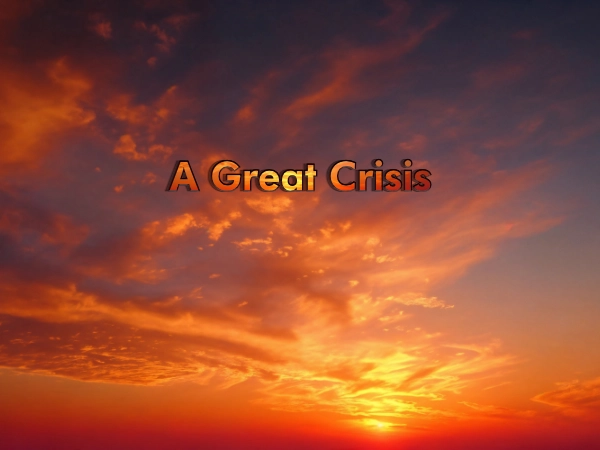
Trinity 25 – Mark 13 1-8
As we approach the end of the year the Scriptures speak to us of the end of the world. Our Gospel reading is from what is called the Little Apocalypse in St Mark’s Gospel.
Jesus is sitting on the Mount of Olives opposite the Temple. From where He was sitting with His disciples you could look across and see what was called the Beautiful Gate of the Temple. There was a Jewish tradition that the Messiah would come down from the Mount of Olives on the Day of Judgment and that the dead would be resurrected at the moment when the Messiah walked through the Beautiful Gate. Those who were buried in the great graveyard of the Mount of Olives were buried with their feet pointing towards the Temple so that they were facing in the right direction when the resurrection happens.
This is what the Temple meant to Jews. But Jesus has just told His disciples that the Temple will be destroyed. He asks them, Do you see all these great buildings? “Not one stone here will be left on another; every one will be thrown down.”
Jesus prophesies a great and terrible crisis. He tells His disciple that they are living in the Last Days before this crisis. He tells them that, Nation will rise against nation, and kingdom against kingdom. There will be earthquakes in various places, and famines. These are the beginning of birth pains.
When a woman goes into labour the birth pains (the contractions) come closer and closer together and become more and more intense. Meaning that the disasters that the Lord speaks of will come closer and closer together and that they will be more and more intense the closer we get to the crisis that He prophesies.
What is this crisis? In 70AD, less than forty years after His death, the Romans destroyed the Temple. Every stone was thrown down. Was this the crisis Jesus speaks of? Or was He also speaking of a greater crisis? Was He speaking of the end of the world and the coming of the Son of Man (Mk. 13.26)? That is what the Church has always taught.
We hear apocalyptic texts like our Gospel today at the end of every year. Perhaps we don’t understand them. Perhaps we just ignore them. They seem like warnings about a day that will never come. But isn’t the news is full of disasters that seem to be getting closer and closer together and becoming more and more intense? Isn’t it possible that we too could be living in the Last Days before another crisis? As one of the great saints of the last century used to say, “It is later than you think! Hasten, therefore, to do the work of God.”
Jesus could return today! Or He could return in a thousand years. We still have to be awake and prepared. Even if Christ doesn’t return to earth in our lifetimes, this fact remains: each one of us will be meeting Him within a number of days perhaps or a number of decades, but the precise moment of this meeting will most likely take us by surprise.
A Great Crisis will be upon us. It will be the end of the world for us. But the strange thing is that this Great Crisis is Good News. It is even something to long for. For the disastrous history of the world has been taken up into the history of God’s mission to share eternal life with us in Jesus Christ. The disciples ask Him about His prophecy. They ask him: ‘when will it all be accomplished?’ And it will be accomplished in His crucifixion and resurrection. What seems like final devastation becomes something new and glorious.
So the Good News is that all our crises only exist relative to a point of stability. Later in the same chapter of St Mark Jesus says,Heaven and earth will pass away, but my words will never pass away (Mk. 13.31).There is a point of stability. This point is infinitely reliable Word of God, which is always creative and re-creative and never destructive.
Perhaps you already know that this is true from your own experience. Your heart has experienced what a Great Crises is like, in your own secret experience of sorrow and sadness and fear. You know what it is like to go through a Great Crisis. In your sorrow you turned to the Word of God and found a point of stability for your life. Perhaps you were able to rest in Jesus’ words: in His promise of victory over death, and in His promise of a love that endures forever. And so perhaps you have begun to discover what awaits you beyond the Great Crisis and even to long for it. For, as St Paul wrote, Eye hath not seen, nor ear heard, neither have entered into the heart of man, the things which God hath prepared for them that love him.
Amen.
The Rev’d Dr James Lawson, St Mary Magdalene Enfield, 17/11/2024
Sep. 27, 2026
Baptism

May. 17, 2026
Ulrich Zwingli and The Sausage

May. 10, 2026
Seeking Fulfilment?

May. 03, 2026
The way, the truth and the life

Apr. 19, 2026
Jesus, Peter and the Path
Apr. 12, 2026
Doubting Thomas?
Mar. 22, 2026
The Resurrection of Lazarus

Feb. 01, 2026
Simeon the Sentry

Jan. 11, 2026
The Suffering Servant

Jan. 04, 2026
The Epiphany

Dec. 28, 2025
Massacre of the Holy Innocents

Dec. 21, 2025
The King’s Arrival
Talks Archive
Trinity 25 – Mark 13 1-8
As we approach the end of the year the Scriptures speak to us of the end of the world. Our Gospel reading is from what is called the Little Apocalypse in St Mark’s Gospel.
Jesus is sitting on the Mount of Olives opposite the Temple. From where He was sitting with His disciples you could look across and see what was called the Beautiful Gate of the Temple. There was a Jewish tradition that the Messiah would come down from the Mount of Olives on the Day of Judgment and that the dead would be resurrected at the moment when the Messiah walked through the Beautiful Gate. Those who were buried in the great graveyard of the Mount of Olives were buried with their feet pointing towards the Temple so that they were facing in the right direction when the resurrection happens.
This is what the Temple meant to Jews. But Jesus has just told His disciples that the Temple will be destroyed. He asks them, Do you see all these great buildings? “Not one stone here will be left on another; every one will be thrown down.”
Jesus prophesies a great and terrible crisis. He tells His disciple that they are living in the Last Days before this crisis. He tells them that, Nation will rise against nation, and kingdom against kingdom. There will be earthquakes in various places, and famines. These are the beginning of birth pains.
When a woman goes into labour the birth pains (the contractions) come closer and closer together and become more and more intense. Meaning that the disasters that the Lord speaks of will come closer and closer together and that they will be more and more intense the closer we get to the crisis that He prophesies.
What is this crisis? In 70AD, less than forty years after His death, the Romans destroyed the Temple. Every stone was thrown down. Was this the crisis Jesus speaks of? Or was He also speaking of a greater crisis? Was He speaking of the end of the world and the coming of the Son of Man (Mk. 13.26)? That is what the Church has always taught.
We hear apocalyptic texts like our Gospel today at the end of every year. Perhaps we don’t understand them. Perhaps we just ignore them. They seem like warnings about a day that will never come. But isn’t the news is full of disasters that seem to be getting closer and closer together and becoming more and more intense? Isn’t it possible that we too could be living in the Last Days before another crisis? As one of the great saints of the last century used to say, “It is later than you think! Hasten, therefore, to do the work of God.”
Jesus could return today! Or He could return in a thousand years. We still have to be awake and prepared. Even if Christ doesn’t return to earth in our lifetimes, this fact remains: each one of us will be meeting Him within a number of days perhaps or a number of decades, but the precise moment of this meeting will most likely take us by surprise.
A Great Crisis will be upon us. It will be the end of the world for us. But the strange thing is that this Great Crisis is Good News. It is even something to long for. For the disastrous history of the world has been taken up into the history of God’s mission to share eternal life with us in Jesus Christ. The disciples ask Him about His prophecy. They ask him: ‘when will it all be accomplished?’ And it will be accomplished in His crucifixion and resurrection. What seems like final devastation becomes something new and glorious.
So the Good News is that all our crises only exist relative to a point of stability. Later in the same chapter of St Mark Jesus says,Heaven and earth will pass away, but my words will never pass away (Mk. 13.31).There is a point of stability. This point is infinitely reliable Word of God, which is always creative and re-creative and never destructive.
Perhaps you already know that this is true from your own experience. Your heart has experienced what a Great Crises is like, in your own secret experience of sorrow and sadness and fear. You know what it is like to go through a Great Crisis. In your sorrow you turned to the Word of God and found a point of stability for your life. Perhaps you were able to rest in Jesus’ words: in His promise of victory over death, and in His promise of a love that endures forever. And so perhaps you have begun to discover what awaits you beyond the Great Crisis and even to long for it. For, as St Paul wrote, Eye hath not seen, nor ear heard, neither have entered into the heart of man, the things which God hath prepared for them that love him.
Amen.
The Rev’d Dr James Lawson, St Mary Magdalene Enfield, 17/11/2024


