

The Suffering Servant
Read Time: 6 mins
May the words of my mouth and the meditations of my heart be always acceptable in your sight, O God my strength and my redeemer. Amen.
Perhaps not may of us go through life with a mission; with an overriding purpose that dictates how we live our life. Oleg Gordievsky was a KGB spy in the Cold War and he had such an overriding mission, applying himself wholeheartedly to his work, eventually rising to become the KGB station chief in London. But during that time and for eleven years he was actually a double agent working for MI6.
Born into the KGB, Gordievsky was recruited by the Russian intelligence service soon after university, and rose swiftly through the ranks. But in 1968 when 2,000 tanks and 200,000 Communist troops invaded and occupied Czechoslovakia, secretly, passionately and permanently, he turned against communism, the KGB and the Soviet state. Gordievsky was a free thinker in a society that punished freedom of thought, and he became convinced that the communist system was barbaric, illiberal and wrong. He was fighting for the wrong side, and needed to do whatever he could to destroy it. He arrived at this conclusion alone, and without any external persuasion. For 11 years he worked for MI6 in the greatest danger, knowing that if he slipped up or was exposed, he would be arrested, tortured and killed. He managed to escape permanently to Britain, but his work for the British led to the breakup of his marriage, as his wife never understood how or why he could betray communist Russia; and after the poisoning of Sergei Skripal, he was mostly confined to his safe-house for security reasons. Gordievsky wasn’t a Christian, but I would argue that his life was enlightened by the true light that is the light of all people, the light of God that came into the world at Christmas in the person of Christ.
For our morality, our conscience, the voice that says to us: this far you shall go and no farther; that inner calling comes from God, who directs all our moral actions. And this is displayed in Jesus’ life. People sometimes ask, why did Jesus have to die? What was it about his ministry, about his approach which meant that that his ministry ended up with his death? This is slightly to ask the wrong question. Jesus’ ministry didn’t happen to result in his death – it was always the point, the end-point of his life and mission. Jesus’ death for us was the fundamental way in which he revealed the nature of the Father, the uttermost nature of the love of God.
As the Letter to the Hebrews says:
“When Christ came into the world, he said,
‘Sacrifices and offerings you have not desired,
but a body you have prepared for me;
in burnt-offerings and sin-offerings
you have taken no pleasure.
[But] then I said, “See, God, I have come to do your will, O God”
…And [so] it is by God’s will that we have been sanctified through the offering of the body of Jesus Christ once for all” [on the cross].
This was Jesus’ overriding mission; the purpose of his ministry.
We are still in the season of Epiphany, and at Epiphany we remember how the wise men brought three gifts: Gold, to recognise that Jesus is King; Frankincense recognises that Jesus was God, like the incense that was burnt in the Temple; but Myrrh, you may recall in the Christmas carol: myrrh’s “bitter perfume [which] breathes a life of gathering gloom; / sorrowing, sighing, bleeding, dying, / sealed in the stone-cold tomb.” Jesus’ body was indeed wrapped in a mixture of myrrh and aloes by Nicodemus and Joseph of Arimathea on Good Friday when they placed his body in the tomb.
Jesus’ ministry was marked out from the very beginning as one leading to his self-sacrifice on the cross – it was the very reason why Jesus, God the Son, came down from heaven, And was incarnate by the Holy Spirit of the Virgin Mary – for us and for our salvation, as the creed puts it.
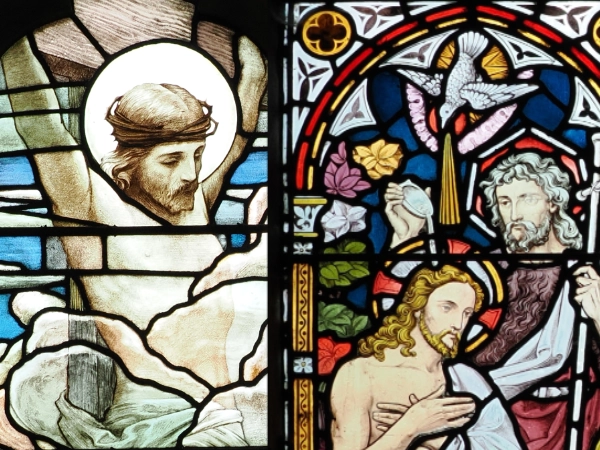
And when Jesus was baptised, as we heard, “suddenly the heavens were opened to him and he saw the Spirit of God descending like a dove and alighting on him. And a voice from heaven said, ‘This is my Son, the Beloved, with whom I am well pleased.’”
‘This is my Son, the Beloved, with whom I am well pleased.’ This is a direct reference to the suffering servant passages in Isaiah, the beginning of which we heard as our first reading: “‘Here is my servant, whom I uphold, my chosen, in whom my soul delights; I have put my spirit upon him’. The Suffering Servant passages in Isaiah continues: “Surely he took up our pain and bore our suffering… he was pierced for our transgressions… the punishment that brought us peace was on him, and by his wounds we are healed… he was led like a lamb to the slaughter, and as a sheep before its shearers is silent, so he did not open his mouth.” The baptism of Christ isn’t merely a recognition by God of Jesus as God’s Son, it marks Jesus’ acceptance of his public ministry as God’s Suffering Servant.
And so as we are incorporated into Christ’s body by our baptism and by Communion with him, may we with grateful thanks be resolutely focused on following Him, as He was resolutely focused on following God, in serving us.
Amen.
The Rev’d Michael Aylmer
St Mary Magdalene Enfield, 11/01/2026

Sep. 27, 2026
Baptism
May. 17, 2026
Ulrich Zwingli and The Sausage

May. 10, 2026
Seeking Fulfilment?

May. 03, 2026
The way, the truth and the life

Apr. 19, 2026
Jesus, Peter and the Path
Apr. 12, 2026
Doubting Thomas?
Mar. 22, 2026
The Resurrection of Lazarus

Feb. 01, 2026
Simeon the Sentry
Jan. 11, 2026
The Suffering Servant

Jan. 04, 2026
The Epiphany

Dec. 28, 2025
Massacre of the Holy Innocents

Dec. 21, 2025
The King’s Arrival
Talks Archive
May the words of my mouth and the meditations of my heart be always acceptable in your sight, O God my strength and my redeemer. Amen.
Perhaps not may of us go through life with a mission; with an overriding purpose that dictates how we live our life. Oleg Gordievsky was a KGB spy in the Cold War and he had such an overriding mission, applying himself wholeheartedly to his work, eventually rising to become the KGB station chief in London. But during that time and for eleven years he was actually a double agent working for MI6.
Born into the KGB, Gordievsky was recruited by the Russian intelligence service soon after university, and rose swiftly through the ranks. But in 1968 when 2,000 tanks and 200,000 Communist troops invaded and occupied Czechoslovakia, secretly, passionately and permanently, he turned against communism, the KGB and the Soviet state. Gordievsky was a free thinker in a society that punished freedom of thought, and he became convinced that the communist system was barbaric, illiberal and wrong. He was fighting for the wrong side, and needed to do whatever he could to destroy it. He arrived at this conclusion alone, and without any external persuasion. For 11 years he worked for MI6 in the greatest danger, knowing that if he slipped up or was exposed, he would be arrested, tortured and killed. He managed to escape permanently to Britain, but his work for the British led to the breakup of his marriage, as his wife never understood how or why he could betray communist Russia; and after the poisoning of Sergei Skripal, he was mostly confined to his safe-house for security reasons. Gordievsky wasn’t a Christian, but I would argue that his life was enlightened by the true light that is the light of all people, the light of God that came into the world at Christmas in the person of Christ.
For our morality, our conscience, the voice that says to us: this far you shall go and no farther; that inner calling comes from God, who directs all our moral actions. And this is displayed in Jesus’ life. People sometimes ask, why did Jesus have to die? What was it about his ministry, about his approach which meant that that his ministry ended up with his death? This is slightly to ask the wrong question. Jesus’ ministry didn’t happen to result in his death – it was always the point, the end-point of his life and mission. Jesus’ death for us was the fundamental way in which he revealed the nature of the Father, the uttermost nature of the love of God.
As the Letter to the Hebrews says:
“When Christ came into the world, he said,
‘Sacrifices and offerings you have not desired,
but a body you have prepared for me;
in burnt-offerings and sin-offerings
you have taken no pleasure.
[But] then I said, “See, God, I have come to do your will, O God”
…And [so] it is by God’s will that we have been sanctified through the offering of the body of Jesus Christ once for all” [on the cross].
This was Jesus’ overriding mission; the purpose of his ministry.
We are still in the season of Epiphany, and at Epiphany we remember how the wise men brought three gifts: Gold, to recognise that Jesus is King; Frankincense recognises that Jesus was God, like the incense that was burnt in the Temple; but Myrrh, you may recall in the Christmas carol: myrrh’s “bitter perfume [which] breathes a life of gathering gloom; / sorrowing, sighing, bleeding, dying, / sealed in the stone-cold tomb.” Jesus’ body was indeed wrapped in a mixture of myrrh and aloes by Nicodemus and Joseph of Arimathea on Good Friday when they placed his body in the tomb.
Jesus’ ministry was marked out from the very beginning as one leading to his self-sacrifice on the cross – it was the very reason why Jesus, God the Son, came down from heaven, And was incarnate by the Holy Spirit of the Virgin Mary – for us and for our salvation, as the creed puts it.
And when Jesus was baptised, as we heard, “suddenly the heavens were opened to him and he saw the Spirit of God descending like a dove and alighting on him. And a voice from heaven said, ‘This is my Son, the Beloved, with whom I am well pleased.’”
‘This is my Son, the Beloved, with whom I am well pleased.’ This is a direct reference to the suffering servant passages in Isaiah, the beginning of which we heard as our first reading: “‘Here is my servant, whom I uphold, my chosen, in whom my soul delights; I have put my spirit upon him’. The Suffering Servant passages in Isaiah continues: “Surely he took up our pain and bore our suffering… he was pierced for our transgressions… the punishment that brought us peace was on him, and by his wounds we are healed… he was led like a lamb to the slaughter, and as a sheep before its shearers is silent, so he did not open his mouth.” The baptism of Christ isn’t merely a recognition by God of Jesus as God’s Son, it marks Jesus’ acceptance of his public ministry as God’s Suffering Servant.
And so as we are incorporated into Christ’s body by our baptism and by Communion with him, may we with grateful thanks be resolutely focused on following Him, as He was resolutely focused on following God, in serving us.
Amen.
The Rev’d Michael Aylmer
St Mary Magdalene Enfield, 11/01/2026


