

The King’s Arrival
Read Time: 4 mins
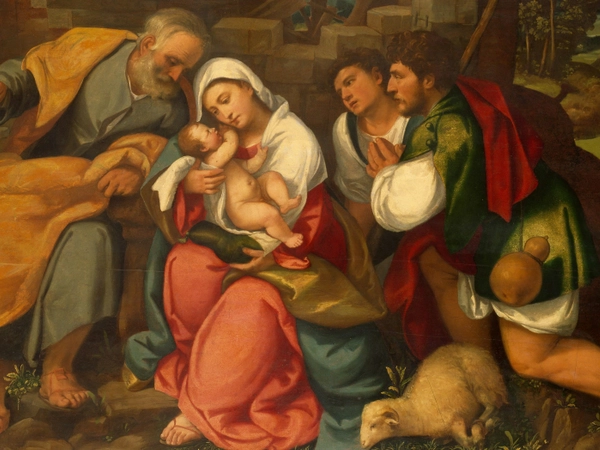
Friends, in today’s Gospel for the last Sunday of Advent, an angel tells Joseph in a dream to name his son Jesus because he will save his people from their sins.
Well, that’s the Good News of Christmas. The rightful King has returned to reclaim what is His and to let the prisoners go free. The God announced by all the prophets and patriarchs—by Abraham, Jeremiah, Ezekiel, Amos, and Isaiah—is a God of justice, and this means that he burns to set things right. God hates the sin and violence and injustice that have made His beautiful world so ugly, and therefore He comes into that world as a warrior, ready to fight. But He arrives (and here is the wonderful irony of Christmas) stealthily, clandestinely—sneaking, as it were, unnoticed behind enemy lines.
The King comes as a helpless infant, born of insignificant parents in a small town of a distant outpost of the Roman Empire. He will conquer through the finally irresistible power of love, the same power with which he made the universe.
There’s a wonderful poem called “Advent Calendar” by Rowan Williams that speaks of how the Sundays of Advent lead to this final revelation.
The Collect in the Book of Common Prayer for the First Sunday of Advent speaks of “Christ coming to visit us in great humility” and coming “in his glorious majesty.” This poem evokes this tone of expectation that marks the season of Advent. It has a constant refrain, “He will come”. The four stanzas take us through the four weeks of Advent.
He will come like last leaf’s fall…
He will come like frost…
He will come like dark…
He will come like child.
He will come like last leaf’s fall.
One night when the November wind
has flayed the trees to the bone, and earth
wakes choking on the mould
the soft shroud’s folding.
Week 1 of the calendar suggests a sudden judgment at the turning of the year. Beautiful autumn turns to bleak and death-like winter, stripped bare – like trees that are stripped bare … only to come to new life when winter turns to spring.
He will come like frost.
One morning when the shrinking earth
opens on mist, to find itself
arrested in the net
of alien, sword-set beauty.
Week 2 is quieter. The frost is stealing silently across a misty landscape that is going into hibernation. It is a tranquil winter day, but all is not as it seems. Suddenly we are made aware of God’s coming judgment.
He will come like the dark.
One evening when the bursting red
December sun draws up the sheet
and penny-masks its eye to yield
the star-snowed fields of sky.
Week 3 takes us on towards the winter solstice and its ‘bursting red December sun,’ the weak winter sun whose strength is spent at the year’s midnight. As night falls, we find ourselves out in the cold, watching, waiting, and longing.
He will come, will come,
will come like crying in the night,
like blood, like breaking,
as the earth writhes to toss him free.
He will come like a child.
The last stanza brings a dramatic conclusion with the fourth and final week ending in marvellous surprise. The threefold ‘will come, will come, will come’ echoes those three comings like knocks on the door. The repetition delays the revelation of what we are waiting for. It is something new – a voice, alive and breathing in a writhing and tossing world. We have been outside in the bleak midwinter, lost and helpless. But we are neither.
Like the morning Eucharist, broken and poured out, Christ comes among us as a Child. Behold, a virgin shall be with child. At the final doors of the Advent Calendar a child is revealed who comes in love. Christmas approaches.
The Rev’d Dr James Lawson
St Mary Magdalene.church 21/12/25
Sep. 27, 2026
Baptism
May. 17, 2026
Ulrich Zwingli and The Sausage

May. 10, 2026
Seeking Fulfilment?

May. 03, 2026
The way, the truth and the life

Apr. 19, 2026
Jesus, Peter and the Path
Apr. 12, 2026
Doubting Thomas?
Mar. 22, 2026
The Resurrection of Lazarus

Feb. 01, 2026
Simeon the Sentry

Jan. 11, 2026
The Suffering Servant

Jan. 04, 2026
The Epiphany

Dec. 28, 2025
Massacre of the Holy Innocents
Dec. 21, 2025
The King’s Arrival
Talks Archive
Friends, in today’s Gospel for the last Sunday of Advent, an angel tells Joseph in a dream to name his son Jesus because he will save his people from their sins.
Well, that’s the Good News of Christmas. The rightful King has returned to reclaim what is His and to let the prisoners go free. The God announced by all the prophets and patriarchs—by Abraham, Jeremiah, Ezekiel, Amos, and Isaiah—is a God of justice, and this means that he burns to set things right. God hates the sin and violence and injustice that have made His beautiful world so ugly, and therefore He comes into that world as a warrior, ready to fight. But He arrives (and here is the wonderful irony of Christmas) stealthily, clandestinely—sneaking, as it were, unnoticed behind enemy lines.
The King comes as a helpless infant, born of insignificant parents in a small town of a distant outpost of the Roman Empire. He will conquer through the finally irresistible power of love, the same power with which he made the universe.
There’s a wonderful poem called “Advent Calendar” by Rowan Williams that speaks of how the Sundays of Advent lead to this final revelation.
The Collect in the Book of Common Prayer for the First Sunday of Advent speaks of “Christ coming to visit us in great humility” and coming “in his glorious majesty.” This poem evokes this tone of expectation that marks the season of Advent. It has a constant refrain, “He will come”. The four stanzas take us through the four weeks of Advent.
He will come like last leaf’s fall…
He will come like frost…
He will come like dark…
He will come like child.
He will come like last leaf’s fall.
One night when the November wind
has flayed the trees to the bone, and earth
wakes choking on the mould
the soft shroud’s folding.
Week 1 of the calendar suggests a sudden judgment at the turning of the year. Beautiful autumn turns to bleak and death-like winter, stripped bare – like trees that are stripped bare … only to come to new life when winter turns to spring.
He will come like frost.
One morning when the shrinking earth
opens on mist, to find itself
arrested in the net
of alien, sword-set beauty.
Week 2 is quieter. The frost is stealing silently across a misty landscape that is going into hibernation. It is a tranquil winter day, but all is not as it seems. Suddenly we are made aware of God’s coming judgment.
He will come like the dark.
One evening when the bursting red
December sun draws up the sheet
and penny-masks its eye to yield
the star-snowed fields of sky.
Week 3 takes us on towards the winter solstice and its ‘bursting red December sun,’ the weak winter sun whose strength is spent at the year’s midnight. As night falls, we find ourselves out in the cold, watching, waiting, and longing.
He will come, will come,
will come like crying in the night,
like blood, like breaking,
as the earth writhes to toss him free.
He will come like a child.
The last stanza brings a dramatic conclusion with the fourth and final week ending in marvellous surprise. The threefold ‘will come, will come, will come’ echoes those three comings like knocks on the door. The repetition delays the revelation of what we are waiting for. It is something new – a voice, alive and breathing in a writhing and tossing world. We have been outside in the bleak midwinter, lost and helpless. But we are neither.
Like the morning Eucharist, broken and poured out, Christ comes among us as a Child. Behold, a virgin shall be with child. At the final doors of the Advent Calendar a child is revealed who comes in love. Christmas approaches.
The Rev’d Dr James Lawson
St Mary Magdalene.church 21/12/25


